
English| EUR
Suggested for you
More currencies
Choose a language
Two hilltowns sit forty minutes apart in the Umbria–Lazio borderland: one built on a tufa plateau with a striped cathedral, the other reachable only on foot across a footbridge. This is orvieto worth visiting guide sets out what each place actually delivers, so the decision is made on evidence rather than on photographs.
Quick answer
Yes — Orvieto rewards a visit, and most travellers extend it to Civita di Bagnoregio, where a 5 EUR conservation fee per person covers the footbridge crossing at Loc. Mercatello, 01022 Bagnoregio VT. Access runs 08:00–20:00 every day of the week. The caveat: the bridge is steep, unshaded and exposed, so an 08:00–09:00 arrival matters in high summer.
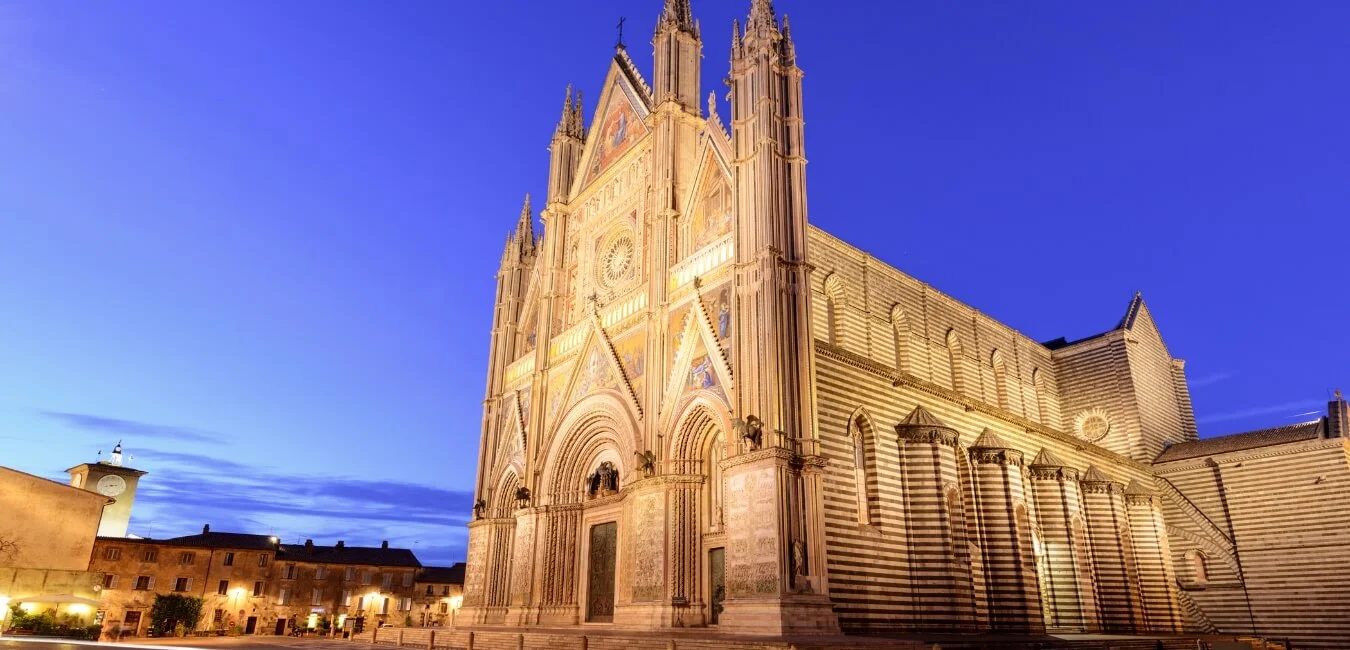
Civita di Bagnoregio has roughly a dozen permanent residents and no road. Every crate of wine, sack of cement and suitcase crosses the same reinforced pedestrian bridge, hauled by hand or by small three-wheeled vehicles. That single constraint explains almost everything about how the site feels, and it is the first thing to weigh when asking is orvieto worth visiting as a base for the wider area. Orvieto answers on different terms. It stands on a butte of volcanic tufa above the Paglia valley, and its density is unusual for a town of its size: the Duomo with Lorenzo Maitani's carved façade and Luca Signorelli's Cappella di San Brizio frescoes; the Pozzo di San Patrizio, a sixteenth-century well with two spiralling staircases that never meet; the Orvieto Underground network of Etruscan-cut caves, cisterns and columbaria beneath the streets. A funicular from Orvieto Scalo lifts visitors from the station to the historic centre, which makes the town one of the easier Umbrian landmarks to reach without a car. Trebbiano and Grechetto vineyards on the surrounding slopes supply the white wine that carries the town's name. What the two places share is scale. Neither absorbs a full day comfortably, and neither is diminished by a half-day. That is why the Orvieto and Civita di Bagnoregio tour has become the standard regional itinerary rather than a compromise: the cathedral and the underground caves in the morning, the belvedere at Bagnoregio and the crossing to Civita in the afternoon, or the reverse for those who prefer the bridge in cool air. Travellers weighing the pairing usually find the question is orvieto worth visiting resolves itself once the second stop enters the calculation. Expectations should be set honestly. Civita is small — a gate, a piazza, a church of San Donato, a handful of lanes ending in sheer drops over the calanchi badlands. It can be walked in under an hour. Its value is not in square metres but in the erosion visible from the bridge, the reason it is often called il paese che muore, the town that is dying. Orvieto, by contrast, holds enough interior detail to justify slowing down: the Signorelli cycle alone occupies most visitors for half an hour. Read the sections below for timing, access and arrival logistics, then plan the day around the crossing rather than the other way round.
“Neither hilltown absorbs a full day comfortably, and neither is diminished by a half-day — which is why the pairing has become the standard regional itinerary rather than a compromise.”
Choosing between Orvieto and Civita di Bagnoregio involves deciding between an expansive, historically dense urban center and a remote, singular hilltop settlement. These locations offer distinct experiences regarding cultural scale and physical terrain.
| Orvieto The Dying City (Civita di Bagnoregio) | Historical Urban Hub Isolated Cliffside Village Recommended | |
|---|---|---|
| Atmosphere | Expansive, bustling historical city | Contained, quiet, and weathered |
| Primary Activity | Cathedral visits, subterranean exploration, dining | Pedestrian exploration and viewing architecture |
| Time Required | 6–8 hours | 2–3 hours |
| Accessibility | Standard road and funicular access | Pedestrian-only bridge access |
| Urban Experience vs Isolated Village | Dense urban infrastructure | Restricted, isolated hilltop site |
Verdict: Select Orvieto for a comprehensive day of urban exploration, or prioritize Civita di Bagnoregio if you prefer a focused visit to a unique, highly preserved geological and historical site.
The optimal window for visiting Civita di Bagnoregio and Orvieto is during the shoulder seasons of spring and autumn to balance mild temperatures with manageable visitor numbers. Aligning your schedule with the official arrival recommendation of 08:00–09:00 ensures access to the village before peak crowds and midday heat.
Mild temperatures ranging 15°C to 22°C. Ideal for walking the bridge and city streets.
Hot and dry with highs near 30°C. Arrive early to mitigate afternoon heat.
Cooler weather from 12°C to 20°C. Frequent clear skies and comfortable light.
— Arrive during the 08:00–09:00 window to avoid daily tourist surges and heat.
Verdict: The concrete best slot is mid-week, arriving between 08:00–09:00, during the months of April, May, September, or October.
Civita di Bagnoregio maintains consistent daily access throughout the week. Visitors can plan their arrival knowing the site remains open during the same hours regardless of the day.
Civita di Bagnoregio is located approximately 30 kilometers south of Orvieto. The most efficient way to travel between these two locations is by private car or taxi, as public transit options are limited.
Follow the SR71 and SP19 south from Orvieto to Bagnoregio
Cotral bus from Orvieto to Bagnoregio (requires transfer at Viterbo)
Direct transfer via local taxi services
If arriving by car, park at the designated lot in the town of Bagnoregio before reaching the pedestrian-only access point. From there, you will proceed on foot along the bridge to reach the village.
Everything you need to know about is orvieto worth visiting
Travelers often ask if orvieto worth visiting, and the answer is yes, as it serves as a perfect cultural base for exploring the Etruscan history and medieval streets nearby. Combining a visit to this city with the nearby cliff-top village provides a comprehensive look at the region. Exploring these central Italian landmarks allows you to see how the landscape shaped local architecture. An Orvieto and Civita di Bagnoregio tour is a convenient way to see both sites without navigating regional transit yourself. Many visitors find that skip-the-line access to local museums in Orvieto complements the walking-heavy nature of the bridge access at the Bagnoregio site. The best arrival window is 08:00–09:00, as this allows you to avoid peak tourist crowds and extreme midday heat. Arriving early provides a quieter experience while walking across the pedestrian footbridge that connects the village to the modern world. There is a 5 EUR conservation fee per person required to enter the village. This contribution supports the maintenance and preservation of the historic town, which faces ongoing erosion challenges. Reaching the site from Orvieto typically requires a car or a guided transfer service. Public transportation options are limited, making direct transit the most efficient way to maintain your schedule. Yes, the village is generally suitable for families, though visitors should note that the access path is a steep pedestrian-only bridge. Parents should be prepared for a walk of about 300 meters from the ticket office to the village gate.
Orvieto and Civita di Bagnoregio Tour from Rome
Read more Tickets & toursAssisi, Orvieto, and Civita Full Day Tour
Read more GuideIs Civita di Bagnoregio Worth Visiting?
Read more GuideCivita di Bagnoregio and Orvieto Bus Guide
Read more Tickets & toursCivita di Bagnoregio Tour from Orvieto
Read more GuideHow to Get to Civita di Bagnoregio from Rome
Read more